
Building lasting wealth doesn’t require picking the next breakout stock—it requires a smart system. This guide delivers a clear blueprint for constructing a resilient portfolio using one powerful approach: etf diversification strategy. Instead of risking your financial future on a handful of individual stocks, you’ll learn how to reduce over-concentration risk through broad, strategic market exposure. Grounded in time-tested portfolio management principles, this article shows you how to simplify investing without sacrificing performance. You’ll discover how to spread risk efficiently, tap into global growth opportunities, and create a durable foundation designed for long-term wealth creation.
ETFs Explained: Instant Diversification in a Single Trade
What exactly is an ETF (Exchange-Traded Fund)? In simple terms, it’s a fund that holds a collection of investments—such as stocks, bonds, or commodities—but trades on a stock exchange like a regular stock. Think of it as buying a sampler platter instead of ordering just one dish (less risk if one choice disappoints).
Here’s where diversification comes in. Diversification means spreading your money across multiple investments to reduce risk. Instead of purchasing 500 individual companies to replicate the S&P 500, you can buy a single S&P 500 ETF and instantly own small portions of all of them. If one company underperforms, its impact is diluted by the other 499. That’s the core of an etf diversification strategy.
Key advantages over mutual funds include:
- Lower average expense ratios (Morningstar reports ETFs often cost less than comparable mutual funds)
- The ability to trade throughout the day at live market prices
- Greater transparency of holdings
Some critics argue ETFs encourage overtrading because they’re so easy to buy and sell. That’s fair. But used thoughtfully, they provide efficient, low-cost exposure to entire markets.
If you’re exploring broader portfolio optimization, consider reviewing tax efficient investing strategies to maximize returns to ensure your gains aren’t quietly eroded by taxes.
The Three-Fund ETF Portfolio: A Simple and Powerful Core Strategy

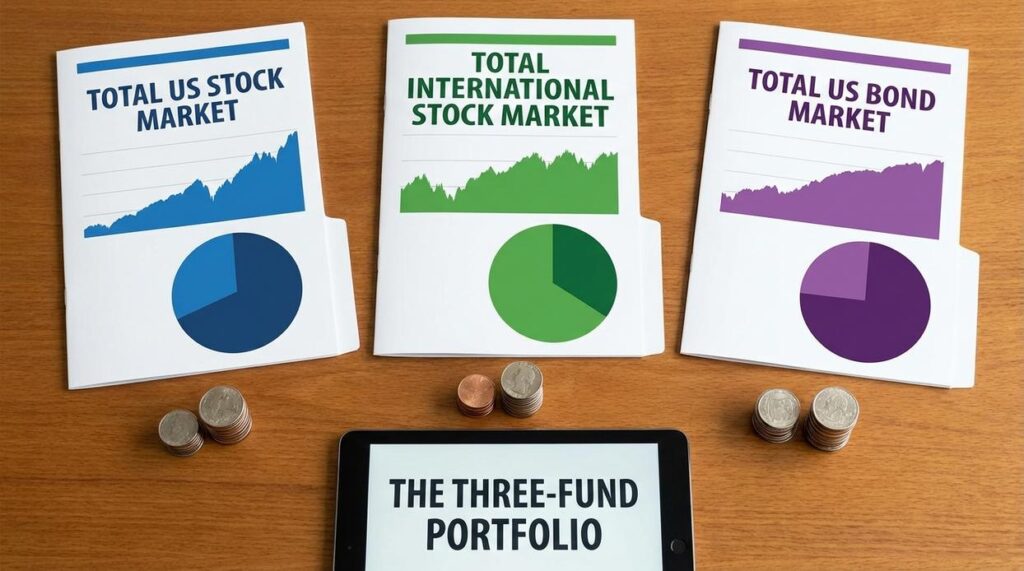
If you’re overwhelmed by endless stock picks, here’s the truth: you don’t need dozens of funds to build serious wealth. You need a focused, disciplined structure. The three-fund portfolio is exactly that—a streamlined, evidence-based core investing framework built for long-term growth.
At its heart, this approach relies on broad-market index ETFs (exchange-traded funds that track a basket of securities). Instead of betting on individual winners, you own the market itself.
Here’s what I recommend:
- Total US Stock Market ETF – Your growth engine. This fund holds thousands of American companies across large-, mid-, and small-cap stocks (market capitalization simply means company size). When the US economy grows, you participate.
- Total International Stock Market ETF – Your global expansion. This includes companies in Europe, Asia, and emerging markets like India and Brazil. If the US hits a slowdown while overseas markets surge, you’re not left behind.
- Total US Bond Market ETF – Your stabilizer. Bonds are loans to governments and corporations. High-quality bonds historically reduce volatility and cushion stock downturns (Morningstar research consistently shows bonds lowering portfolio drawdowns).
A practical starting allocation:
- 40% US stocks
- 20% International stocks
- 40% US bonds
That 60/40 split has decades of historical precedent for balancing growth and stability (see Vanguard long-term asset allocation studies).
This etf diversification strategy works because it eliminates guesswork. You’re not predicting the next Apple or Nvidia. You’re capturing global capitalism itself (which, historically, has been a decent bet).
Recommendation: Start simple. Automate contributions. Rebalance once per year. Adjust stock/bond percentages based on risk tolerance—more stocks for long time horizons, more bonds as stability becomes priority.
Sometimes the smartest move in investing isn’t complexity. It’s clarity.
Beyond the Core: Using Sector and Thematic ETFs for Targeted Growth
Once your core portfolio is in place, you can layer in smaller, tactical positions through specialized ETFs. Think of these as your portfolio’s “boosters” (the side quests, not the main storyline).
Sector and Thematic Plays With Purpose
Sector ETFs let you overweight a specific slice of the economy—technology, healthcare, financials, or energy. For example, technology represented over 28% of the S&P 500 in 2023 (S&P Global), reflecting its outsized market influence. If you believe AI-driven productivity will continue expanding, increasing tech exposure may align with that conviction. Historically, sector rotation strategies have shown measurable performance differences depending on economic cycles (Fidelity research).
Thematic ETFs go a step further. Instead of mirroring traditional sectors, they target long-term structural trends like clean energy, robotics, or cybersecurity. The global cybersecurity market alone is projected to exceed $500 billion by 2030 (Cybersecurity Ventures). That’s powerful growth potential—but also HIGHER VOLATILITY. Many thematic funds experience wider price swings than broad-market ETFs, especially during rate hikes (Morningstar data).
Critics argue these funds are hype-driven and prone to boom-and-bust cycles. Fair point. In 2022, several innovation-focused ETFs declined more than 50% from their peaks (Morningstar). That’s exactly why they should complement—not replace—your core etf diversification strategy.
Keep “satellite” holdings to 5–10% of your portfolio. PRO TIP: Rebalance annually to prevent one hot theme from quietly taking over.
Investors love ETFs, but mistakes erode returns. Mistake #1: Overlap. Holding an S&P 500 ETF, a large-cap growth fund, and a total market ETF means you own Apple and Microsoft three times. That is not diversification; it is duplication dressed up as strategy (a closet full of t-shirts). Mistake #2: Chasing performance. Buying last year’s hottest thematic fund after a 60% run often locks in hype, not gains. Mistake #3: Ignoring expense ratios. A 0.40% fee versus 0.03% can compound into figures over decades (SEC data shows fees impact returns).
- Audit holdings quarterly
- Prioritize a etf diversification strategy
Your Next Step Towards a Resilient Portfolio
You set out to solve the risk of portfolio concentration—and now you know ETFs offer a simple, low-cost solution. By embracing an etf diversification strategy, you replace guesswork with structure and reduce the danger of overexposure to any single stock or sector.
A core mix of broad-market stock and bond funds creates the resilient foundation your long-term wealth deserves. You don’t need to outsmart the market—you need to diversify intelligently.
Don’t let concentration risk stall your growth. Research the three core low-cost ETFs today, put your plan into action, and start building a stronger, more resilient portfolio now.
 Founder & Chief Executive Officer (CEO)
Caelina Vaythanna is the kind of writer who genuinely cannot publish something without checking it twice. Maybe three times. They came to wealth growth perspectives through years of hands-on work rather than theory, which means the things they writes about — Wealth Growth Perspectives, Capital Investment Models, Expert Breakdowns, among other areas — are things they has actually tested, questioned, and revised opinions on more than once.
That shows in the work. Caelina's pieces tend to go a level deeper than most. Not in a way that becomes unreadable, but in a way that makes you realize you'd been missing something important. They has a habit of finding the detail that everybody else glosses over and making it the center of the story — which sounds simple, but takes a rare combination of curiosity and patience to pull off consistently. The writing never feels rushed. It feels like someone who sat with the subject long enough to actually understand it.
Outside of specific topics, what Caelina cares about most is whether the reader walks away with something useful. Not impressed. Not entertained. Useful. That's a harder bar to clear than it sounds, and they clears it more often than not — which is why readers tend to remember Caelina's articles long after they've forgotten the headline.
Founder & Chief Executive Officer (CEO)
Caelina Vaythanna is the kind of writer who genuinely cannot publish something without checking it twice. Maybe three times. They came to wealth growth perspectives through years of hands-on work rather than theory, which means the things they writes about — Wealth Growth Perspectives, Capital Investment Models, Expert Breakdowns, among other areas — are things they has actually tested, questioned, and revised opinions on more than once.
That shows in the work. Caelina's pieces tend to go a level deeper than most. Not in a way that becomes unreadable, but in a way that makes you realize you'd been missing something important. They has a habit of finding the detail that everybody else glosses over and making it the center of the story — which sounds simple, but takes a rare combination of curiosity and patience to pull off consistently. The writing never feels rushed. It feels like someone who sat with the subject long enough to actually understand it.
Outside of specific topics, what Caelina cares about most is whether the reader walks away with something useful. Not impressed. Not entertained. Useful. That's a harder bar to clear than it sounds, and they clears it more often than not — which is why readers tend to remember Caelina's articles long after they've forgotten the headline.