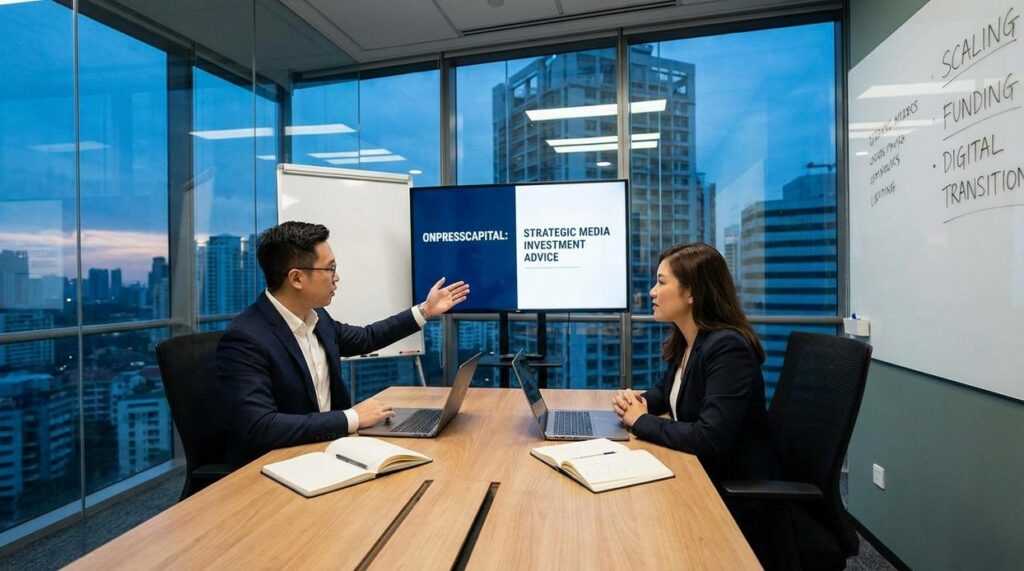
I’ve reviewed thousands of pitch decks at Onpress Capital. Most founders make the same mistakes before they even get in the room.
You’re probably here because you want to know what actually works when pitching to us. Not generic VC advice. What we specifically look for.
Here’s the truth: most founders waste months pitching to funds that were never going to invest in them. Wrong stage. Wrong sector. Wrong fit.
I’m going to walk you through exactly how to approach Onpress Capital for funding. What we care about in your pitch. What makes us say yes or no.
This isn’t theory. This is how our investment process actually works.
We believe in transparency from the start. You shouldn’t have to guess what we’re thinking or decode vague feedback. That’s why I’m laying out our criteria, our process, and what separates a strong pitch from one that goes nowhere.
You’ll learn how to prepare before you reach out, what to include in your deck, and how we run due diligence.
By the end, you’ll know if we’re the right fit for your company. And if we are, you’ll know exactly how to position yourself for the best shot at getting funded.
No guessing. Just a clear roadmap.
Understanding Our Investment Thesis: Are We the Right Fit for You?
Let me be direct.
We don’t invest in everything. And that’s probably a good thing for both of us.
I focus on early-stage technology companies. Specifically, Seed to Series A rounds where the potential for scale is real but the risk is still high.
Some investors say you should spread your bets across every sector and stage. They argue that concentration is dangerous. And sure, there’s logic there.
But here’s what I’ve learned.
When you try to be everything to everyone, you end up being nothing to anyone. I’d rather go deep in areas where I actually understand what makes companies win.
Where We Put Our Money
I look at four main sectors. Each one has something that gets me excited about the next decade.
B2B SaaS is where I see businesses solving real problems for other businesses. The recurring revenue model works. Companies can scale without burning through cash like it’s going out of style.
FinTech is rebuilding how money moves. Not the flashy consumer apps that disappear in two years. I mean the infrastructure that makes financial services actually work.
HealthTech matters because healthcare is broken in ways that technology can fix. When you find a company that makes care more accessible or affordable, that’s worth paying attention to.
AI-driven platforms are different from AI features slapped onto existing products. I’m talking about companies where AI is the core of what they do (not just a marketing buzzword).
You can check out more of my thinking in this commerce guide Onpresscapital if you want the full breakdown.
What I Actually Look For
Here’s what matters when I evaluate a company.
| What I Need to See | Why It Matters |
|---|---|
| ——————- | —————- |
| Massive TAM | Small markets cap your upside no matter how well you execute |
| Early product-market fit | User engagement and revenue tell me people actually want this |
| Strong unit economics | You need to make money on each customer eventually |
| Real competitive advantage | Something that keeps competitors from eating your lunch |
The TAM question is simple. If you win, how big can you actually get? I’m not interested in companies fighting over scraps.
Product-market fit shows up in the data. Are users coming back? Are they paying? What do the testimonials actually say? (You can usually tell when founders cherry-pick the good ones.)
Unit economics separate real businesses from cash furnaces. I want to see a path where each customer generates more value than they cost to acquire and serve.
The moat is what protects you when competition shows up. And competition always shows up. Proprietary technology works. Network effects work. Unique data works. A slightly better version of what already exists? That doesn’t work.
If you’re building something that checks these boxes, we should talk. If not, that’s fine too. Better to know now than waste each other’s time.
This approach isn’t for everyone. But for the right founders building in the right spaces, it’s exactly what business advice onpresscapital is built around.
Crafting the Perfect Pitch: The 10 Slides We Need to See
Your pitch deck isn’t just a presentation.
It’s your first product. And if it’s messy or unclear, I’m going to assume that’s how you build everything else.
I’ve sat through hundreds of pitches at onpresscapital. The ones that get funded? They follow a pattern. They’re clean, they’re direct, and they answer my questions before I ask them. At Onpresscapital, I’ve observed that the most successful pitches not only capture attention but also anticipate and address potential concerns, creating a seamless dialogue between creators and investors. At Onpresscapital, the art of pitching transcends mere presentation, as the most compelling proposals not only engage the audience but also demonstrate a keen understanding of what investors truly seek.
Let me walk you through what I need to see.
Slide 1: The Vision & Mission
Give me one sentence that explains what you do and why it matters. Not three sentences. Not a paragraph. One.
If you can’t explain your company in a single line, you don’t understand it yet.
Slide 2: The Problem
Show me the pain point you’re solving. Use real numbers to prove it’s worth solving.
I don’t want to hear about theoretical problems. I want to see data that makes me wince.
Slide 3: The Solution
Now show me how you fix it. Screenshots work better than descriptions. Demos work better than screenshots.
Don’t just tell me your product is elegant. Prove it.
Slide 4: Market Size & Opportunity
Here’s where most founders lose me. They throw out massive TAM numbers without explaining how they’ll actually capture any of it.
Validate your market size. Then tell me your realistic strategy for grabbing a piece that matters.
Slide 5: The Product & Traction
Give me the metrics that prove you’re moving. MRR, user growth, churn rates. Whatever shows momentum.
Early stage? That’s fine. But show me something is working.
Slide 6: Go-to-Market Strategy
How will you get customers without burning through cash? I need to see a plan that scales.
Paid ads? Partnerships? Word of mouth? Just make it believable.
Slide 7: The Team
Why are you the right people to build this? What have you done that proves you can win here?
I’m betting on people as much as ideas. Show me why you’re worth that bet.
Slide 8: Financial Projections
Three to five year projections. Keep them realistic.
I’ve seen enough hockey stick charts to know they’re usually fiction. Sound assumptions beat wild optimism every time.
Slide 9: Competitive Landscape
Who else is doing this? And what makes you different in a way that actually matters?
Saying you have no competitors just tells me you haven’t looked hard enough.
Slide 10: The Ask
How much are you raising? What milestones will this capital help you hit?
Be specific. Vague asks get vague responses.
That’s it. Ten slides that tell your story without wasting my time. We explore this concept further in Commerce Guide Onpresscapital.
Your deck should make me want to take the next meeting. Nothing more, nothing less.
Beyond the Pitch: Navigating Our Due Diligence Process

Let me be clear about something.
Due diligence isn’t an interrogation. It’s not me trying to catch you in a lie or poke holes in your business just because I can. In the spirit of transparency, it’s crucial for gamers and investors alike to stay informed about the latest developments, such as the Economy Updates Onpresscapital, which can significantly influence market dynamics and overall gaming experiences. In the spirit of transparency, it’s crucial for gamers and investors alike to stay informed about the latest developments, such as the Economy Updates Onpresscapital, which shed light on the evolving landscape of in-game economies and investment opportunities.
Here’s what it actually is: a partnership test drive.
You’re deciding if I’m the right investor for you. I’m deciding if I can truly help your company grow. We both need to be sure before we commit to years together.
Some founders think they should hide weaknesses during diligence. They believe showing any cracks will kill the deal. I’ve seen teams scramble to cover up problems or oversell their metrics.
Bad move.
Here’s what they don’t understand. I WANT to find issues. Not to walk away, but to know what we’re working with. The companies that succeed are the ones that show me their challenges upfront so we can tackle them together.
What I Actually Look At
I focus on four main areas.
Financial diligence means I’m reviewing your historical numbers and cap table. I want to see the assumptions behind your model. Are they grounded in reality or wishful thinking? (Most founders lean optimistic, which is fine as long as you know it.)
Technical diligence is where I dig into your tech stack and product roadmap. I’m not trying to rebuild your architecture. I just need to know if it’ll scale when you 10x your customer base.
Customer and market diligence is simple. I talk to your customers. I ask them why they love your product or what frustrates them. This tells me more than any pitch deck ever could.
Team diligence rounds it out. Reference checks and real conversations with your key people. Culture matters more than most founders admit.
Here’s my advice: PREPARE YOUR TEAM BEFORE WE START.
Make sure everyone knows diligence is coming. Get your financials organized. Have your customers ready to chat. Don’t wait until I ask for something to start looking for it.
The whole process takes about four to six weeks from our first deep dive to a final decision. Some founders think that’s too long. They want an answer tomorrow.
But think about it. You’re not buying a coffee maker. You’re choosing a partner who’ll be in your cap table for years. A few weeks of thorough vetting protects both of us.
Want better business advice onpresscapital allocation and investor relations? Start treating diligence as a collaboration, not a test you need to pass.
Show me the real picture. I’ll show you if we’re a fit.
The Intangibles: Founder Traits That Signal Success
You can have the perfect pitch deck and still fail.
I’ve seen it happen. Founders with beautiful financials and polished presentations who couldn’t make it past year two.
Here’s what I’ve learned after backing dozens of startups. The spreadsheets matter less than the person sitting across from me.
Some investors will tell you that’s too subjective. They say you should stick to hard metrics and ignore gut feelings about character. That data is all that counts.
But they’re missing something important.
When things go sideways (and they always do), your financial projections won’t save you. The founder will.
I invest in people first. The business model can change. Your target market might shift. But the quality of the founder? That stays constant.
So what am I actually looking for?
Grit. Not the kind you claim in an interview. The kind I can see in your track record. Show me you’ve faced real challenges and didn’t quit when it got hard.
I want to see deep knowledge of your industry. Not surface level stuff you picked up in three months of research. I’m talking about years of experience that give you an unfair advantage. This ties directly into what we cover in Commerce Advice Onpresscapital.
Coachability matters more than most founders think. Can you hear feedback without getting defensive? Will you challenge your own ideas when the data says you’re wrong?
(This is where a lot of smart people stumble. Being right matters less than being willing to adapt.)
The best founders I work with have what I call a maniacal focus on their customer. They’re not building features they think are cool. They’re obsessed with solving one specific problem really well.
When you nail these traits, everything else gets easier. Your team will follow you through tough times. Investors will want to back your next venture. Customers will stick around even when competitors show up.
That’s the real value here. These aren’t just nice-to-have qualities. They’re what separate the founders who make it from the ones who don’t. In the competitive landscape of gaming startups, understanding the intricate dynamics of market trends and consumer behavior, as emphasized in the Commerce Guide Onpresscapital, can be the decisive factor that propels founders from obscurity to success. In the competitive landscape of gaming startups, leveraging insights from the Commerce Guide Onpresscapital can be the crucial differentiator that propels founders towards success by helping them navigate market trends and consumer behavior effectively.
For more context on how these founder qualities play out in different market conditions, check out economy updates onpresscapital.
The metrics will tell you if a business can work. But these intangibles? They tell you if it will.
Your Next Step Towards Partnership
You now have the complete playbook for securing investment from Onpress Capital.
I’ve walked you through our thesis, what we look for in founders, and how to prepare for due diligence. You know what matters to us.
The path to funding is challenging. But clarity and preparation are your greatest assets.
When you align your startup and your pitch with these principles, you show us something important. You’re the kind of thoughtful, prepared founder we want to partner with.
Here’s what to do next: Review your company against our investment criteria. Make sure the fit is real, not forced. Then reach out and start the conversation.
We’re looking for category-defining companies. If that’s what you’re building, let’s talk.
The future needs bold founders who can execute. If that’s you, we’re ready to build it together.
 Founder & Chief Executive Officer (CEO)
Caelina Vaythanna is the kind of writer who genuinely cannot publish something without checking it twice. Maybe three times. They came to wealth growth perspectives through years of hands-on work rather than theory, which means the things they writes about — Wealth Growth Perspectives, Capital Investment Models, Expert Breakdowns, among other areas — are things they has actually tested, questioned, and revised opinions on more than once.
That shows in the work. Caelina's pieces tend to go a level deeper than most. Not in a way that becomes unreadable, but in a way that makes you realize you'd been missing something important. They has a habit of finding the detail that everybody else glosses over and making it the center of the story — which sounds simple, but takes a rare combination of curiosity and patience to pull off consistently. The writing never feels rushed. It feels like someone who sat with the subject long enough to actually understand it.
Outside of specific topics, what Caelina cares about most is whether the reader walks away with something useful. Not impressed. Not entertained. Useful. That's a harder bar to clear than it sounds, and they clears it more often than not — which is why readers tend to remember Caelina's articles long after they've forgotten the headline.
Founder & Chief Executive Officer (CEO)
Caelina Vaythanna is the kind of writer who genuinely cannot publish something without checking it twice. Maybe three times. They came to wealth growth perspectives through years of hands-on work rather than theory, which means the things they writes about — Wealth Growth Perspectives, Capital Investment Models, Expert Breakdowns, among other areas — are things they has actually tested, questioned, and revised opinions on more than once.
That shows in the work. Caelina's pieces tend to go a level deeper than most. Not in a way that becomes unreadable, but in a way that makes you realize you'd been missing something important. They has a habit of finding the detail that everybody else glosses over and making it the center of the story — which sounds simple, but takes a rare combination of curiosity and patience to pull off consistently. The writing never feels rushed. It feels like someone who sat with the subject long enough to actually understand it.
Outside of specific topics, what Caelina cares about most is whether the reader walks away with something useful. Not impressed. Not entertained. Useful. That's a harder bar to clear than it sounds, and they clears it more often than not — which is why readers tend to remember Caelina's articles long after they've forgotten the headline.